Uhuru Simba
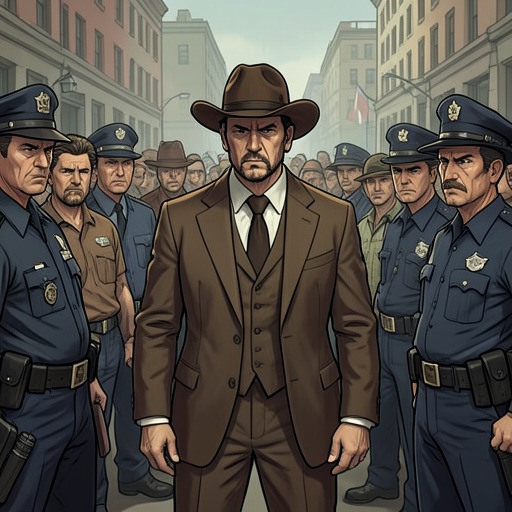
The Satanic VersesUhuru Simba, formerly Sylvester Roberts, is a Black political activist whose arrest and death in custody become a flashpoint in Brickhall. He is introduced both as a prominent opponent of racialized media representation and as a figure whose public authority is complicated by reports of violence against women. The novel never resolves the circumstances of his death: an official account attributes it to a nightmare, while his family and supporters point to unanswered questions about his treatment in custody. Around that uncertainty, the city’s competing accounts of justice harden into conflict.
Identity and Public Presence
Simba is known publicly as Dr. Uhuru Simba, though the narrative does not establish what his doctorate is in. His birth name, Sylvester Roberts, remains significant: his mother Antoinette Roberts later invokes it while insisting that she means no disrespect to the name he chose. The contrast between the names registers both his self-fashioned political identity and his family’s continuing relationship to the person behind it.
He has become a recognizable activist in Brickhall before Saladin Chamcha’s return to the public scene. Simba leads a successful protest against The Aliens Show, and his presence in the campaign is associated with mass pickets and a forceful challenge to the show’s racial politics. Hal Valance, the show’s creator, treats Simba as a formidable opponent and dismisses his protest rather than engaging with its claims. Under pressure, Valance removes Chamcha from the programme and replaces him with a blond, Teutonic performer in prosthetic makeup and computer-generated imagery. He also replaces Mimi with a sexualized white character. The changes are presented as an attempt to depoliticize the show, but they preserve its commercial ambitions while removing the performers and images that made its racial framing visible.
Political Image and Personal Conduct
Simba’s political profile does not make him an uncomplicated representative of the community. Mishal Sufyan tells Chamcha that Simba, whom she knows as Sylvester Roberts from New Cross, has assaulted her in public. The account also describes his violence toward women as known to people around him. Jumpy Joshi acknowledges this history when Simba’s arrest becomes a cause for public protest, but argues that it does not prove Simba committed the murders for which he is accused. Mishal is among the women present at the protest meeting, a reminder that the political coalition assembled on his behalf includes people who have personal reasons not to excuse his conduct.
That tension matters to the campaign. Jumpy distinguishes between Simba’s behavior in his personal life and the question of whether he is guilty of the Granny Ripper murders, warning against treating an accused man’s reputation as proof of a separate crime. Chamcha, by contrast, raises Simba’s record as a reason for caution. The exchange leaves the contradiction in view: defending Simba against a potentially unjust prosecution need not erase the harm attributed to him, even as his actions toward women do not settle the murder case.
Arrest and Public Campaign
Simba’s arrest brings immediate fear to the Shaandaar Café. Hanif Johnson arrives to warn the Sufyans that police have arrested Simba for the Granny Ripper murders and may also make him a scapegoat for a supposed Black Magic case. Hanif expects reprisals to follow and urges the family to secure the premises. His warning connects the criminal allegations to a wider racialized suspicion in which Simba may be cast as a threatening occult figure as well as a murder suspect.
Pamela Chamcha and Jumpy join the campaign protesting his arrest. Jumpy describes the prosecution case as circumstantial and vulnerable to challenge, and anticipates that the authorities may pressure witnesses or produce testimony against Simba. He argues that the case is political because Simba has been a conspicuous voice in the community. At a public meeting, the organizers call for supporters to attend court, picket, and raise money. The campaign thus seeks not only to contest the charges but also to make the justice system answerable to people who fear that the case has already been decided in public.
Antoinette Roberts gives the meeting its most forceful account of Simba’s public role. Recalling his appearance at committal proceedings, she describes him as filling the courtroom with his presence and speaking directly to the prosecutor. She presents his self-identification as an uppity Black man and his refusal to appear reasonable as deliberate political acts. In her account, Simba argues that migrants from many communities have been changed by crossing oceans in search of work and dignity, but can also remake British society. His mother turns his court appearance into a claim about political agency: those treated as outsiders are not merely asking to be included but asserting a right to shape the country.
Death in Custody
While awaiting trial, Simba dies in custody. Brickhall’s community liaison officer, Inspector Stephen Kinch, describes the death as an extraordinarily unlikely accident. The police account says Simba had a terrifying nightmare, screamed in his sleep, and fell from the lower bunk, dying immediately. It is presented as an official explanation, not as a conclusion independently established by the narrative.
Antoinette Roberts rejects the language of chance and addresses a crowd outside the police station. She argues that describing the death as a million-to-one occurrence makes the community’s survival seem a matter of odds rather than a matter of human worth. Hanif Johnson, acting as Simba’s solicitor, adds specific reasons for suspicion: Simba allegedly fell from the lower of two bunks, the upper bunk was unoccupied, and the only witnesses to the death were prison officers. He notes that an empty bunk was unusual in an overcrowded system of custody and disputes the assumption that a nightmare is the only explanation for the screams. The narrative preserves the difference between the police account and the family’s challenge without confirming that Simba was killed.
The death also gives Simba’s mother and supporters a new public role. Antoinette speaks from the back of her younger son Walcott Roberts’s pickup truck, while Hanif addresses the crowd and connects the official description to the racist language used to diminish Black lives. The family’s grief becomes a public argument over whose testimony can be trusted and whose death is treated as consequential. Simba cannot answer the allegations or the official account himself; others speak for him, but their claims remain divided.
Aftermath and Narrative Significance
Simba’s death widens the conflict rather than closing his case. Many white observers accept his death as a fitting end for a man portrayed in the press as a violent monster. In Brickhall, however, anger grows among young Black and Asian residents, who regard the competing official and communal judgments as evidence of a deeper struggle over safety and credibility. Police numbers increase, football matches are cancelled, and attacks on Black families, harassment of schoolchildren, and reports of police brutality intensify the sense of a city under pressure. Community self-defence patrols begin moving through the borough.
Hanif tells Mishal that another Granny Ripper killing could ignite the situation, because the killer appears to be mocking both his freedom and Simba’s death. Soon afterward, Gibreel Farishta comes through the streets on a humid night, blowing his golden horn. Simba’s story therefore remains active beyond his own life: the unresolved death becomes part of the atmosphere in which violence, political protest, and extraordinary events converge. His character embodies neither an uncomplicated heroic resistance nor a settled account of guilt. Instead, the novel makes his contested reputation and contested death a measure of how racial power shapes public sympathy, criminal suspicion, and the right to be believed.